
Discover how modern enterprises build resilient, secure digital infrastructure. Learn the core pillars of zero trust, identity management, and endpoint security.
Building Secure Digital Infrastructure for Modern Businesses
In today's hyper-connected economy, digital infrastructure is no longer just a supporting function for operations—it is the very engine of business growth. From cloud-hosted microservices and SaaS tools to a distributed, remote workforce, modern enterprises rely on complex, decentralized ecosystems to deliver value.
However, this rapid digital expansion has fundamentally changed the threat landscape. The traditional network perimeter is dead. With employees accessing corporate resources from various locations, networks, and devices, businesses can no longer rely on a simple "castle-and-moat" security model. Building a secure digital infrastructure now requires a proactive, multi-layered approach that integrates security directly into the fabric of the technology stack.
Here is a comprehensive guide to building a secure, resilient digital infrastructure that protects your critical assets while enabling agility and growth.
1. The Zero Trust Paradigm: Verify Explicitly, Trust None
At the core of modern secure digital infrastructure is the principle of Zero Trust. The foundational philosophy is simple: never trust, always verify. Under a Zero Trust model, identity and access are verified at every stage, regardless of whether the request originates from inside or outside the corporate network.
Implementing Zero Trust involves three core tenets:
- Verify Explicitly: Always authenticate and authorize based on all available data points—including user identity, location, device health, service or workload, and data classification.
- Use Least Privilege Access: Limit user and service access with Just-In-Time (JIT) and Just-Enough-Access (JEA) models, protecting data with risk-based adaptive policies and data protection.
- Assume Breach: Minimize blast radius and segment access. Use end-to-end encryption, continuous monitoring, and automated threat detection to identify anomalies in real time.
By adopting Zero Trust, organizations ensure that even if one endpoint or credential is compromised, the attacker cannot freely traverse the corporate network.
2. The Four Pillars of Secure Digital Infrastructure
A secure infrastructure stands on four essential pillars. To build a robust security posture, enterprises must address each of these areas concurrently.
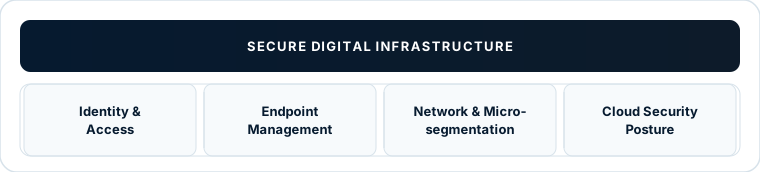
Pillar A: Identity and Access Management (IAM)
Identity is the new perimeter. Organizations must implement robust IAM systems that enforce strong authentication controls.
- Multi-Factor Authentication (MFA): Deploy phishing-resistant MFA (such as FIDO2/WebAuthn keys or biometric authentication) to block unauthorized login attempts.
- Single Sign-On (SSO): Centralize access control across all SaaS and internal applications to streamline user management and ensure prompt offboarding.
- Role-Based Access Control (RBAC): Ensure that employees only have access to resources necessary for their specific job functions.
Pillar B: Endpoint Management and Security
With hybrid work models, the devices accessing corporate data are diverse and geographically dispersed.
- Unified Endpoint Management (UEM): Maintain centralized visibility and control over all corporate and personal devices (BYOD) accessing the network.
- Endpoint Detection and Response (EDR): Go beyond traditional antivirus. EDR solutions continuously monitor endpoints for behavioral anomalies and automatically quarantine suspicious processes.
- Continuous Patching: Automate OS and third-party software updates to remediate vulnerabilities before they can be exploited.
Pillar C: Network Segmentation and Micro-segmentation
Flat networks are a major security liability. If a hacker breaches one system, they can easily pivot to others.
- Virtual Local Area Networks (VLANs): Separate public-facing systems, developer environments, finance databases, and guest networks.
- Micro-segmentation: Apply granular security policies to individual workloads within virtualized or cloud environments, restricting lateral movement down to the container or virtual machine level.
Pillar D: Cloud Security Posture Management (CSPM)
As businesses migrate workloads to the cloud, configuration drift and misconfigured access rules become significant risks.
- Automated Configuration Audits: Continuously scan cloud infrastructure against compliance standards (such as CIS Benchmarks, ISO 27001, and SOC 2).
- Encryption at Rest and in Transit: Ensure all databases, object storage, and API communications are encrypted using industry-standard protocols (AES-256 and TLS 1.3).
3. Practical Steps to Modernize Your Infrastructure Security
Transitioning to a secure digital infrastructure does not happen overnight. It requires a structured roadmap.
- Map Your Digital Assets: You cannot protect what you do not know exists. Conduct a thorough audit of all hardware, software, cloud instances, and data repositories.
- Define Security Policies: Establish clear rules regarding remote access, device compliance, data sharing, and password management.
- Deploy Continuous Monitoring: Establish a Security Operations Center (SOC) or partner with a Managed Security Service Provider (MSSP) to achieve 24/7 visibility into system logs and event data.
- Integrate Automation: Use automated remediation to block suspicious IPs, isolate compromised devices, and deploy critical patches without waiting for manual intervention.
Conclusion: Security as a Business Enabler
Building a secure digital infrastructure is not a roadblock to productivity—it is a business accelerator. Organizations with robust security postures can adopt new technologies faster, enter regulated markets with confidence, and build deeper trust with their customers and partners.
At InvisoCore Technologies, we help businesses design, deploy, and manage secure digital infrastructures that adapt to the demands of modern operations. By focusing on zero trust architecture, comprehensive endpoint management, and proactive compliance, we help strengthen the resilience of your technology stack against evolving threats.
Contact the InvisoCore team today to evaluate your current security posture and build a roadmap for a secure digital future.
Ready to strengthen your technology foundation?
InvisoCore Technologies helps businesses design, deploy, and manage secure IT infrastructure, endpoint management, cloud platforms, and connected business systems.