
Discover why complete endpoint visibility is critical for scaling businesses. Learn how to eliminate IT blind spots, secure remote workforces, and block threats.
Why Endpoint Visibility Matters for Growing Companies
As a business transitions from a small startup to a growing enterprise, its operational footprint expands rapidly. More employees mean more devices—laptops, smartphones, tablets, virtual machines, and cloud instances—accessing company databases, communication tools, and proprietary source code.
While this expansion is a clear sign of success, it introduces a major IT challenge: visibility. In many growing organizations, IT departments struggle to answer a fundamental security question: Can you list every single device currently connected to your network or accessing your cloud data?
In cybersecurity, there is a golden rule: you cannot secure what you cannot see. Here is a detailed look at why stronger endpoint visibility is a cornerstone of security and compliance for growing companies, and how to improve it.
1. The Growing Blind Spot: Remote Work and BYOD
In the early stages of a business, managing IT is relatively simple. Everyone works in the same office, using standardized machines on a single, local network.
As the company scales, however, several factors complicate this setup:
- Remote & Hybrid Teams: Employees connect from home routers, public Wi-Fi networks, and co-working spaces across different regions.
- Bring Your Own Device (BYOD): To save costs and increase flexibility, companies allow staff to access work emails and Slack channels from their personal phones or personal laptops.
- Shadow IT: Individual departments purchase and use SaaS tools or software applications without consulting the central IT team.
Without proper endpoint visibility, these factors create massive blind spots. An unmonitored personal laptop with outdated software accessing company source code represents an open door for malware, ransomware, and data exfiltration.
2. The Strategic Benefits of Complete Endpoint Visibility
Endpoint visibility is not just about audit checklists; it has real, tangible benefits for business operations and defense.
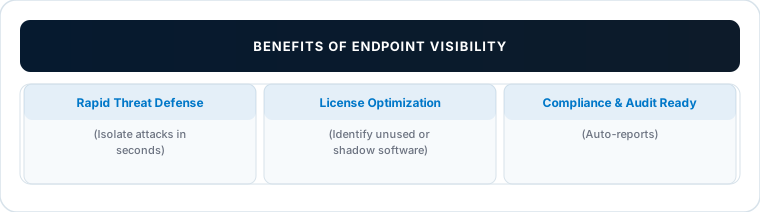
Benefit A: Proactive Threat Detection and Mitigation
If a device on your network is compromised by ransomware, time is your enemy. Without endpoint visibility, it can take days to identify which device is infected and where it is located. With real-time visibility, security teams can:
- Instantly locate the compromised device.
- Analyze what processes are running on it.
- Isolate the device from the network remotely to prevent lateral spread.
Benefit B: Elimination of Shadow IT and License Waste
Endpoint visibility tools do not just track hardware; they track running applications. This allows growing companies to:
- Identify unauthorized software (shadow IT) that could expose corporate data.
- Detect underutilized software licenses, enabling IT managers to downgrade or cancel subscriptions and save significant budget.
Benefit C: Streamlined Compliance and Auditing
Customers often need to evidence control over data assets against frameworks such as ISO 27001, SOC 2, HIPAA, or local data privacy laws (like the UAE Data Protection Law). Endpoint visibility platforms can help by providing automated logs of hardware and software configurations that support audit preparation and reporting.
3. The Real Cost of "Invisibility"
What happens when a company lacks endpoint visibility? The consequences go beyond simple IT inconvenience:
- Extended Dwell Time: Industry reports show that threats can remain undetected for long periods. Without visibility, malware can sit silently on an employee's machine, collecting keystrokes and system credentials.
- Audit Failures: Missing inventory details can lead to failed compliance audits, resulting in lost client trust and potential regulatory fines.
- Inefficient Troubleshooting: IT support teams waste hours asking users for system configurations, serial numbers, and OS versions when resolving routine technical issues.
4. How to Strengthen Endpoint Visibility
Building stronger visibility requires a combination of modern tooling and clear security policies.
- Implement a Unified Agent: Deploy a lightweight software agent on all corporate-owned devices. This agent should run silently in the background, reporting hardware health, OS patch status, and installed software to a central console.
- Enforce Zero Trust Network Access (ZTNA): Configure your network gates so that if a device does not have the compliance agent installed, it is blocked from accessing corporate resources.
- Establish a Dynamic Inventory: Move away from manual spreadsheet tracking. Use automated asset discovery tools that update in real time as new devices connect to the cloud or local networks.
Conclusion: Visibility is the Foundation of Growth
For a growing company, scaling securely means ensuring that technology enablement does not outpace security controls. By investing in endpoint visibility, you lay a secure foundation that allows your workforce to work from anywhere, on any device, without putting company assets at risk.
At InvisoCore Technologies, we help businesses improve visibility into their endpoint ecosystems. Our solutions deliver real-time data on device health, software configurations, and security postures, giving your IT team clearer insight to defend your digital borders.
Ready to eliminate your IT blind spots? Contact InvisoCore today to schedule an endpoint visibility assessment.
Ready to strengthen your technology foundation?
InvisoCore Technologies helps businesses design, deploy, and manage secure IT infrastructure, endpoint management, cloud platforms, and connected business systems.